Tuesday, 17 April 2012

Family Reunion

A family reunion is always an exciting affair as the comedy Madea’s Family Reunion has shown.  In our case, among other things, it was even more thrilling since a member of the family had arrived on a massive dual purpose bike never seen in this part of the world.  For most of my village folks who have never travel more than 100kms away from home in their lifetime, it was hard to work out that I had travelled 5500kms from South Africa on a bike.  This state of affair was understandable given that none one was willing to believe that a bike was capable of travelling such great distances.  This belief was compounded by the Indian made Bajajs they ride, which is not only air cooled, but is of such low power that it was obvious a trip on a bike was not possible.  This said the commonest mode of transport is the bicycle; it is a way of life. 
Bicycles used for Common Transport In Africa

To return to the main story of family reunion, it was the first time we had gathered as a clan.  Naturally my arrival had created a buzz and drawn members of the family from far and wide.  Well, it has always done so.  I have been living out of the country for the last fifteen years, so my return home has always generated excitement not only within the family circles but also among the neighbours, I believe also because I am the only clan member who lives abroad on a permanent basis.   So returning to my rural home is quite an event.


My rural village has neither electricity nor running water as well as most of the modern amenities.  Yet it is home in the most intimate way.  Coming from the hustle and bustle of metropolitan Johannesburg, Abwanget ― for this is the name of my village ― is heaven.  The serenity I find in this remote, quiet wooded land is of its kind.  Such is the peace that you rarely hear the roar of a car engine.  My folks genuinely love.  They will roast their last chicken for you, if you are their visitor.  It is another world where humanity in its total description is without pretence.  It is in this ambience that Christmas descended on us.  We remained in this festive stupor well after the New Year, during which many family businesses took place: meetings, importantly baptisms of three members of the family at Toroma Catholic Church.  Much of the time however was spent on delights of feasting: drinking “ajono” our local brew, braaing and dancing to the local tunes.  In this way the days passed quickly.
Toroma Catholic Church Where the Baptism Took Place

One day, after the last family photo, many hugs, farewells and tears, I set off on a return journey to Johannesburg on the 2nd of January at eleven o’clock.  I had two weeks of rest.  Indeed, my mind, body and soul were adjusted to tackle the long ride to Johannesburg. 

It was a clear hot day with an azure sky.  Fred, my brother, and his wife accompanied me for the first leg of the trip to Soroti where I refuelled, lubricated my chain and headed for the Kenyan border about 160kms South East.    I rode decidedly hard wanting to cover as much rode as I could.  At Malaba, the boarder, it was raining hard.  There was a bit of delay crossing the Ugandan boarder because there was only one custom officer to clear my bike who was busy.  Cleared, I rolled through the no-man’s land into Kenya.  I immediately faced two problems in Kenya: I had to pay for third party insurance of about 35$; I had to persuade the custom officials that I was in transit and did not require a carnet du passage.  I can assure you based on the experiences of riders around the world; it pays to be able to speak the language of the host country.  After much haggling with the custom officials they let me go, but only after paying for the third party insurance. 
Just Me

I wish to recall that when I lived in Dar es Salaam some year back, I distinctly disliking to sojourn in Kenya.  When travelling from Dar es Salaam, I always ensured I spent the night at Arusha, the following day I would drive through Kenya to Uganda.  So, as I rode towards Bungoma the sun was setting on the Western horizon, I wished there was some more day light left so that I could ride further than Bungoma.  I felt uneasy especially since this road was used by transport hauliers and long distance buses; I rode with much caution.

I arrived at Bungoma and went to look for a place to pitch my tent.  The first place I asked was some sort of inland resort, they were hostile to the idea of pitching a tent.  So I went back to the main road to Nairobi and drove some distance towards Kakamega where I found a Total petrol station. They allowed me to pitch my tent.  After some food and a bottle of beer, I passed out thinking that the following day was going to be an exciting day and thanking my dear Lord for an eventless day.

Tuesday, 20 April 2010

Into The Pearl of Africa

It was relieving to have reached halfway the journey.  I would take as much rest as possible but also tour Uganda.  It’s a beautiful country.  Being on the equator it has diverse flora and fauna from equatorial forests to arid desert like conditions of the north east.  Winston Churchill visiting the country (1908) called it the ‘pearl of Africa'. Lake Victoria, the second largest fresh water body in the world is a beautiful spectacle to behold.  The Rwenzori mountain is one of the very few on the continent that has snow on its peak, the River Nile the second longest in the world passes through its territory.  Uganda has diverse cultures, diverse food varieties and has some of the most hospitable people on planet; it is simply a place one must visit in one’s life time.   Here I was enjoying all it beauty.
 Red Mark Showing Loose Bolts and Nuts
I was exhausted from the many days of riding.  It had taken ten days and about 5100kms of tough riding.   All I wanted was ample rest.  Indeed the days that followed, I spent long hours lazying away in bed, occasionally babysitting little Gabbie, Fred’s newest member of the family. 
Giving Scorpion a Thorough Check
Following five days of rest, it was time to give Scorpion some real attention.  To begin with I tightened all bolts and nuts on the chassis.  I was surprised how many were loose.  The worst of them were two bolts and nuts holding the headlamps.  These had fallen off soon after I left Zambia somewhere in the southern part of Tanzania.  I heard noise but only saw the magnitude of the problem today.  I had the right mirror welded and fitted back as well as had my panniers panel beaten.  Scorpion was also due for service.  Gave her an oil and oil filter change, as well as cleaned the air filter.  It was the first time I was doing this change and was ably assisted by Fred my sibling. 
Showing Mileage Covered
Christmas was just around the corner.  So I spent some time travelling around the country.  I went to Arua which in the North West of Uganda, it was during this trip that I sneaked into the DRC.
 Friends from High School Days: Twins
Manufacturing Peanut butter the Traditional Way
Market Day
Market Day: the Turkey Vendor
Market Day: the Chicken Vendor
Market Day: Vendor Transporting Chicken
Foreground: A garden of Cassava

Sunday, 4 April 2010

Farewell To Rwanda

 The countryside of Rwanda
Sunday was overcast and a gloomy day; it turned out to be utterly uneventful. I stayed in bed for a while, but later spent the morning washing my Firstgear riding gear to rid it of dirt, mug and odious odour. There was a problem though —water was a very scarce commodity in Kigali. It disconcerted me that the Great Lake Region, rich in water bodies and lying at the equator was plagued by incessant water problems: scarcity and pollution. In Kigali all of it had to be bought for my washing. By contrast, Johannesburg has no lakes, its water is imported from as far as Lesotho, yet in the seven years I have lived in Jozi, never have I experienced any water problems. The water is clean to the extent that we drink it from the taps; it never requires any boiling, filtering or treating. So one wonders what makes the Lake Region different. Why can’t the responsible authorities do the same? The quandary as I have always argued is management and all the attendant troubles. Problems of services delivery are associated invariably with management. Bad leaders don’t deliver.
Tea Estates of Rwanda
Another matter occupied my mind. It was time to resume the odyssey — to Uganda. Territorially speaking, I was about to hit the halfway mark of the odyssey. My feelings about the sojourn in Rwanda were mixed. I had definitely enjoyed being in the country. It was a wonderful beautiful country made of wonderful people who had out of sheer will and desire survived and outlived the Genocide. It was something to talk about — indeed a remarkable feat. We had all witnessed the tenacity of the human capacity to beat all odds in order to keep the species and the nation going. It was a place, I convinced myself, I would visit in the future. Yet in spite of these pleasurable sentiments I was troubled at heart. I was troubled because I had come to visit Esperance all the way from Johannesburg. But she had shown little appreciation. When a visitor especially one coming from so far away arrives, don’t you play the host? Don’t you at least smile? Or must it be in the spirit of the old adage: “call a spade a spade” and give the supposedly offending visitor a cold shoulder? I was cold shouldered. I still I have no answer. Since I did not know Esperance as a person, I let the matter be. Still I remained disturbed. I could not shake off the feeling. I argued with myself: how could she be so cold and aloof. What about African hospitality? It is not a universal virtue.
The Countryside of Rwanda-1
In this mood I left Rwanda: the country and people I had so much come to identify with. The evening was long and boring. My imagination refused to come to my aid. I had one thing on my mind: to leave first thing in the morning.

Fortunately, I slept sound and deep except for an occasional infuriating buzz from a mosquito. I have learnt in the course of growing up that when I have a problem, I may agonise, rationalise, and in extreme cases loose my appetite; but sleep is one thing I never surrender. Problems go away with time, so why not retain my sanity so that when the problem is gone, I am still the healthy jovial person I am.

At the first light of the day I was ready to depart, but I needed some cash to take care of sundries. At 7:00 o’clock Muhire and I rolled into the city centre, exchanged dollars for Rwandese Francs and set off towards the border. My host accompanied me for 70kms. We hugged and bid farewell to each other. I departed heading north. Muhire was such a decent man. I wished the sister too was decent.
 Inside Uganda
Today my intention was to ride hard. I assumed that I would be in Kampala by lunch time (13:00 hours), I was so wrong because I arrived only at 18:00 hours. In slightly more than an hour I was at Katuna border post. It was a smooth ride in a beautiful country side surrounded by high hills covered in lush green forests, tea fields, among others. The road was in a good state although busy since it was part of the Great North Road. The border had many hauliers going both directions; but in ten minutes I was on my way again. The immigration officials and the police officers were very polite and friendly. I rolled into Uganda in style. Obviously coming on a huge bike was not a common sight, and for another reason; I was a son of the land returning home. As it were, in this part of the world, the most common bikes are 50-125 cc. The big bikes are usually police bikes in the VIP motorcades.

On the Ugandan side, I had to clear customs before proceeding to immigration. The officer was extremely kind and I thought very sensible. He checked my papers; I paid about 20$ for tax. The colleague of the custom officer helping me tried to solicit a bribe out of me by persuading his colleague to make entry difficult for me. I overheard them arguing. The man helping me said that he was not going to compromise his morals. It was extremely gratifying to learn that there are people who have ideals and values that they hold. It is common knowledge according to the World Audit (2009); Uganda is the 74th most corrupt country in the world. So I was not surprised by this attempt to profiteer from me.
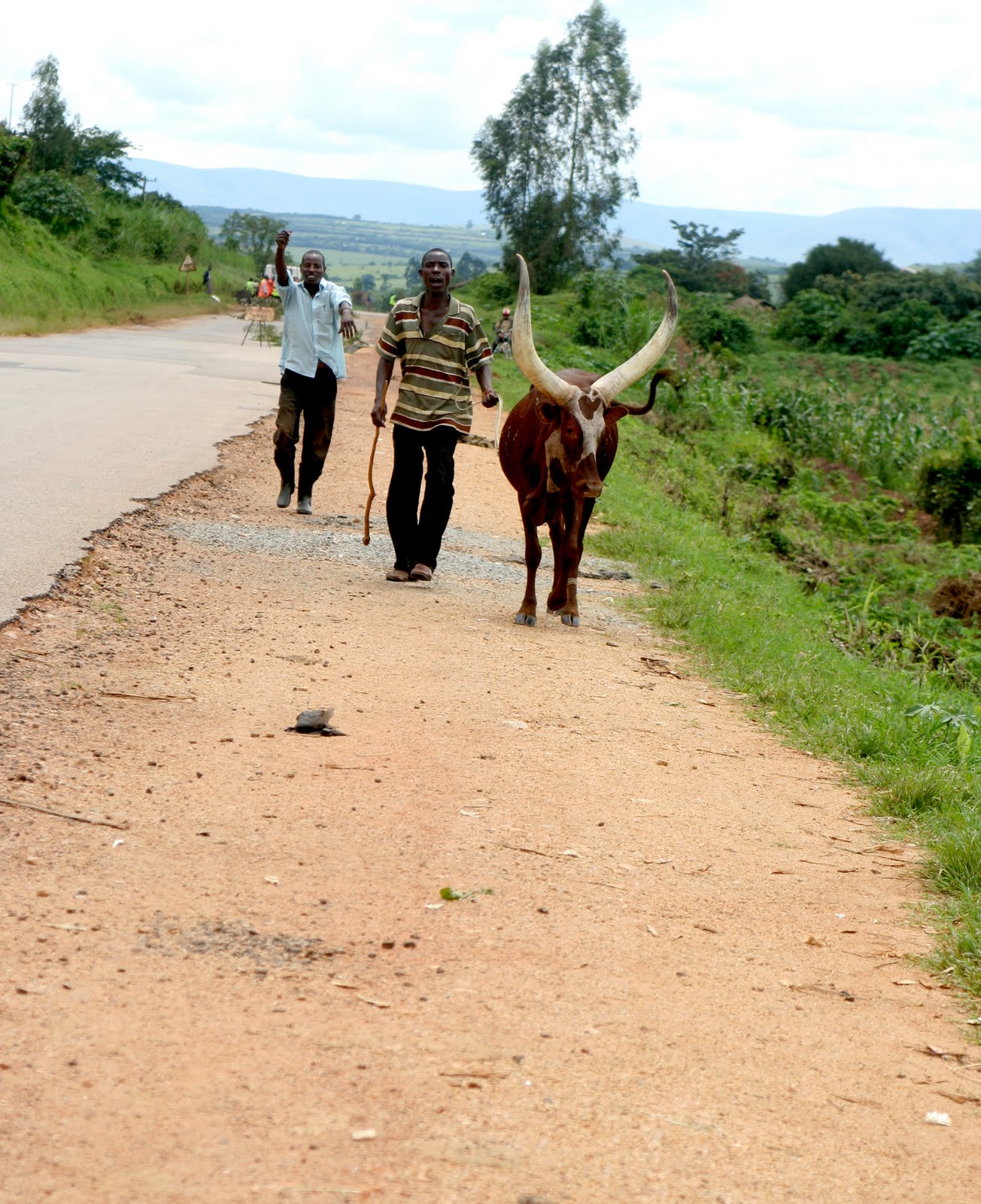
The Famous Ankole Cattle
I left the border determined to enjoy the ride. The roads were not as good as those I had left behind. They were very bumpy because of the bad patch work. They were also very narrow. I could not understand how Rwanda had better roads compared to Uganda for obvious reasons. There were very long stretches of bad sections and sometimes untarred parts. I can say with much confidence that of all the roads I drove on, Uganda had the worst road system. In spite of this, I was enjoying the scenery of rolling hills shrubbed in lush green. I rode though Kabale and Rukungiri. Towards Mbarara the landscape turned arid and uninteresting. Of all the riding I had done and was to do, this stretch was the most boring, laboured and left me feeling vulnerable. I stopped only to refuel and to eat. I took no photographs, and was especially angry that I had failed to photograph a man daggling the biggest and most magnificent catfish and tilapia I had ever seen. It was a lost opportunity. In this mood I rolled into Kampala. Fred my brother took me home where I slept for the next four days.

Tuesday, 23 March 2010

My Love for Kigali

 City Centre in the background and Kigali Memorial
I woke up feeling thankful. I had come some 4500kms. I was in good health and Scorpion was still running efficiently. As I lay on my host’s bed I planned the day; it was a Saturday. First, Scorpion was my chief concern; she needed of some attention. She was caked in mud; a thorough wash was on the menu. I also wanted to see Kigali, familiarise myself with political developments and find some entertainment.

Rwanda is no Libya in population. Though it is a small country, it has a population of over 10 million people, one of the highest densities in sub-Saharan African — 240 people per sq km. This was manifest as soon as I crossed the border: on the streets as well as the residential places were hives of people. Yet, I still thought Burundi held the crown — I had never seen as many people as I saw on the streets of Burundi.

Meanwhile, breakfast was simple: bread and tea. I would have preferred a plateful of boiled rice, cassava or potatoes for that is what I grew up eating. Whereas bread was European and tea was Chinese, these were in my view the ultimate colonial legacies. My conundrum was the mentality around these legacies. A case for argument: in my high school days to eat bread and drink coffee or tea was equated to being ‘civilized’. We all know this to be a warped mentality. By the same token, to speak English with a foreign accent was likened to being uncivilized. What was forgotten was that one comes from a cultural background, which unavoidably influences one’s ways of being. Speaking of ‘being’, one culture, plainly put, cannot be superior to another; it is simply different. If such a thing as a superior culture exists, it is merely a belief. We know beliefs are sacrosanct.
Housing Estate in Kigali
In the years I was a principal of a secondary school in Tanzania, it always amused me that my students, who had never been any where near America, spoke English with an American accent or shall we say spoke American English. Why was this so? What was wrong with speaking English with a Tanzanian enunciation? The Indians do it. The Russians speak English in Russian, and so do the Afrikaaners. Even Microsoft Corporation has come to accept the imperative of cultural differences, so that under language entries in its software are the following: English (UK), English (Zimbabwe) English (American), English (Jamaican), English (South African) because it is alright to be different. So what was wrong with being Tanzanian? I saw the need to deconstruct this mentality. One day I asked some students a question I supposed they still ponder to this day: “Have you ever heard an American speak in English or in Kiswahili with a Tanzanian pronunciation? I leave the rest to your fertile imagination.

Don’t get me wrong—I have nothing personal against my cousins overseas; yet, it is necessary that folks start appreciating themselves culturally. It is simply not acceptable that the more you sound like the queen, the better person you are. What defines a person is character, integrity, humanity and the like. In my view the lack of these are the sources of our human nuisances.

It seems I had wondered off in a mental reverie. Well, soon afterwards, Muhire and I set-off towards the city centre. It was a beautiful cool morning following the night down pour; the warmth of the sun was very delightful.

We soon arrived at car wash. What was unique about it was not the absence of high tech. Recall I was coming from Johannesburg, but rather the presence of basic old common sense. In bid to find employment for its youth, the Rwandese government had organised all street kid into some sort of associations. Car washing was one of them and motorcycle taxis (locally called boda boda) was another. In this manner, the Rwandese went far in solving crime and employment using common sense. In my view it was working, a leaf the city of Johannesburg could lend itself to solve some of its perennial problems.
For a fee of 1500 Rwandese francs, these youth scrubbed the mud off Scorpion. The mud was everywhere to the extent that to this day I have not been able to get rid of it completely. After two hours of waiting, Scorpion was sparkling and had regained some of her former glory. Then Muhire decided that we were ready to go site seeing.
Life Went On  A wedding.
Kigali is built on several rolling hills. This however was not what impressed me. It was the fast pace of development, unmistakable in the construction taking place in the district of the city. A prominent sight is the tallest building marking the city centre — although nothing of the sort seen in the skyscrapers’ of New York. Furthermore, this conspicuous development is seen in the phasing out of slums and ghettos. The progression is so palpable that one can distinguish the new from the old. In Muhire’s words, the original owner of the land in the slum is given the first right to develop the land or alternatively is compensated money-wise, or given land elsewhere. All this construction was in keeping with the government’s 2020 Vision to modernise Kigali and Rwanda. It is common knowledge that because of the leadership of the government of Rwanda, things have tended to work with the efficiency of a clock. It is said that any citizen can telephone President Kagame to report a problem. Corrupt government officials of any rank are prosecuted and jailed. The police is a people’s police in the very essence of what they do.
A Seventh Day Adventist Wedding
I have always maintained that the positive progress a state, a company, a family or any institution makes is rooted in the leadership who leads with a vision, passion, efficiency, discipline and integrity. These are virtues persons possess: — either one has them or not. It does not matter how popular one is, the direction of progress takes on a very definite character. An example in America’s political landscape will illuminate our minds. America has had forty-four presidents since independence yet only a couple of them standout: the founding fathers, Abraham Lincoln, Franklin Roosevelt, Harry S. Truman, and J. F. Kennedy; they made a difference. The ordinary man on the streets of Kigali will tell you with fervour that Kagame is their man. Why because he makes a difference in their lives. This is what leadership is about. Emerging from the genocide of 1994, it was possible for Rwandese to wallow in self-pity. Kagame insists that Rwandese must take self-agency seriously and change their circumstances instead of waiting for the government to do something for them. For instance — a very small example but one that shows the significance of the change of attitude — every month on a Saturday, all citizens are called to participate in a project of keeping Rwanda clean: everyone from the president to the humblest man on the street participates. Rwanda along with Singapore are reputed to be the cleanest countries in the world, a journalist claimed.
The Good Things of Life
That afternoon I visited the genocide memorial. To come to Rwanda and not visit the memorials is to miss a historical event that defines the destiny of the Rwandese people. There are many sites around the country but Muhire took me to Kigali Memorial Centre, organised along the lines of the Apartheid Museum of Johannesburg. The memorial tell the individuals stories of those who were butchered by fellow Rwandese from infants to the old, the weak, pregnant women and the infirmed—every one was affected. I walked into that building into total silence disturbed only by the breeze outside, the distant drone of car engines, birds chirping, my footsteps and my breathing. I paced slowly through the corridors and the rooms. Hundred of photos lined the walls, accompanied by narrations of the events leading to the genocide. Further on downstairs I came to a room bearing the remains — the actual bones of the genocide victims: hundreds of skulls bearing the evidence of a mortal blow. I had only the afternoon, but it was a place you could not visit in a rush. I had many questions racing through my mind. Honestly, I did not have answers.

I remember reading somewhere that after the 9/11 events, some Americans had questioned why God had allowed these things to happen. In my little faith, it was so clear; I couldn’t doubt that God had nothing to do with this. It was easy to shift the blame to some other source — in this case completely disregarding human capacity for free will and choice, which in my view God respects. But this is besides the point in this narration. My consolation, however, was that the true heroes were all the Rwandese people, who having learnt from the events of the genocide, had decided to forge ahead with their lives. I left the memorial that evening in a very pensive mood, but with even more questions.
Wedding Match
The evening was not helped by Esperance's absence. I had come to visit her, having come all the way from Johannesburg;  she had gone off to a wedding returning a few minutes before I departed for the night. I was livid but kept my cool, I knew what to do.

Sunday, 14 March 2010

The Love Affair that Soured

--> -->
Towards Rwanda
In both Rwanda and Burundi, one drives on the right side of the road.  It took some getting used to this new way of driving especially at traffic circles.  As I drove towards Kigali, I kept thinking of my long association with the Rwandese people. It elated me.  Rwanda was a fascinating country:  its history, politics, culture as well as the beauty of its female species.  It was rumoured that Rwandese and Ethiopian women were the most stunning in the world.  But that aside, the Rwandese people unbeknown to me were involved in my life from my child days. 

Rwandese according to historical accounts shares the same ancestry with the Banyankole of Uganda.  In fact, as a child, I often thought of them as Banyankole.  In the Eastern part of Uganda, we thought they were the best cattle herders.  Being cattle keepers ourselves, it was a common practice to hire a mulalo (acronym for Rwandese) to herd our cattle.  They were mostly paid in kind at the end of the year by giving them a heifer animal or more depending on the size of the herd.   My grandfather Ananias who lived to a ripe old age of 120, and had fought for the British in the Great Wars had several of them tending his herds.  I was completely oblivious of the fact that they were actually refugees. 

In my little mind, I never knew that they had such a horrid history that led to the genocide of 1994.   Unavoidably, the genocide is a spectacle that continues to appall me.  I lived in a war ridden Uganda of the 70s and 80s and had seen people die for various reasons.  But still I cannot fathom a country of two people tribes butchering one another because one of them suffers from a superiority complex.  I know this is simplistic but just suppose by way of comparison, according to Encyclopedia Brittanica, Tanzania has 120 tribes, Uganda has 47 and no one knows how many there are in the Democratic Republic of Congo since some of its jungles are yet to be discovered.  Imagine what would happen if Tanzanians turned against each other? 
A Street in Kigali
I had seen the bodies on television; I had read the stories in news papers.  I had discussed the matter with Peter my roommate (at Makerere University), who was a Rwandese.  It was rumoured that Rwandese had constituted the bulk of Museveni’s fighting force during the struggle to oust Obote and those who succeeded him.  And now I was riding on the roads of this beautiful country whose story had captured the imagination of the world.  We all remember too well that the UN had stood by as these people butchered each other.  Every category of people seem to have participated in some way or another in the genocide including priests and nuns of the Catholic Church.  They had turned against each other or participated by denouncing any one who was not of their kind.

I remember being very frightened of these events and feeling hopeless and helpless.  I remember crying while watching hundreds of bodies bloated and floating on Lake Victoria.  Holocaust or genocide, it was simply terrible that rational humans could savagely turn against each other and do unspeakable things. 
Mr Muhire My Host and Guide
I was deep in thought and paid little attention to my surrounding as I drove towards Kigali.  I was here to pay homage to all those who had lost their lives fifteen years after the event. In my culture, paying homage to a dead one never ends. I remember that 15 years after my maternal grandfather passed on, relatives from one of his wives came to pay homage.  It was huge function.

Sad as the story of Rwanda might be, I had also come here for another very special reason— a matter of the heart.  I was going to meet a beautiful Rwandese, Esperance with whom I had been communicating for a while.  It was a secret I had guarded closely.  At the border, I telephoned her to say I was an hour away from Kigali. I arranged with the brother to meet at the city centre.  I was partly here at the invitation of the family. 

One thing which gripped my attention as I headed towards the interior was the cleanliness of the country. There was no dumping anywhere, a common feature of most places I traversed.  But even more remarkable was the absence of plastics: bottles or bags.  Who does not know about the curse of plastics?  A documentary on National Geographical Channel had revealed that this menace had even registered its presence in the seas of the South Pole where it was wrecking environmental havoc.  You need not look far, but in the water gutters and channels to see the stamp of this cancer.  The curse of plastics! 

As I rode, I looked around for evidence of the genocide; there was none.  The ordinary folks of Rwanda went about their chores. If you had arrived from another planet and had never heard of the genocide, there was no apparent suggestion that 15 years ago neighbours had slaughtered each other.

Mr Muhire, Esperance’s brother met me about 3:30pm Rwandese time. He was a handsome young man just after his mid 20s.  He had recently completed his law degree and spoke fluent English.  You will recollect that Rwanda was French speaking but was in the process of becoming ‘Anglophone’.  He took me home to his cottage where I had bath.  Later that evening, we went to his elder brother’s home where among others I met Esperance.  In her photo, she was an absolute stunner, which explains why I had satisfied myself with contemplating her ‘diagram’ (Idi Amin’s soldiers’ language), a permanent residence of my wallet I whip out and espied at the slightest opportunity. 

The family had received me warmly.  As we dinned, I had delighted them with the tales of my odyssey.  They were so enchanted and entertained that they wanted to hear more.  But I was simply so tired that I had to beg them to allow me retire for the night. 
Modernity in Kigali
As we walked home, I had confided in Muhire that I was happy he was putting school above everything else.  I said to him that with Education, he would never go wrong.  And that although it was a costly investment, and sometimes the returns were long in coming, it was a good investment.  We had spoken long into the night during which I drifted off into a deep slumber.  Even the mosquitoes, of which there were plentiful, failed to upset my sleep.

Sunday, 28 February 2010

My Burundian Experiences

Although Rumonge was a large town by Burundian standards, I easily found Chez David. It was a large building in Victorian style in the middle of the business enclave. Since most folks in town seem to know it, I assumed it was a major hotel. It did not have running water, and electricity worked only for half the night. Despite this shortcoming, it was clean, well run, safe and with an exciting night life
A View of Lake Tanganyika From Burundi
 Papa Libanga who welcomed me hailed from the DRC; he was the receptionist as well as the manager — a very pleasant man in his late 50s. After securing a room, I had one thing on mind — to stuff myself. I told the chef I wanted a typical Burundian dish. It turned out to be my favourite grilled fish presumably from Lake Tanganyika served with baked potatoes. While the meal was cooking, I took a bath. It was a cold evening, so I requested for hot water which was delivered to my room in a plastic bucket. After a while, I returned to the foyer to wait for my fish. I took a look around. This included sampling some Burundian lager — Primus — in the biggest bottle I had yet set eyes on. I chose a strategic spot overlooking the foyer. I sat unaccompanied taking in details of the surrounding environs.

As it were, French, Kiswahili and Kirundi were the languages spoken so communication was possible with the first two. It was the first time I was in Burundi. Geographically, it was a very beautiful country lush green rolling mountains as far as the eye could see. The good roads provided for fabulous riding, which was what I was here to do. The people were very kind and generous.

I must confess that it was the country I least spent time with the local folks. But like Rwanda, its people had a fair share of suffering — the Hutu-Tutsi hegemony that had unfolded over the decades culminating in the death of President Melchior Ndadaye at the outbreak of the Rwandan Genocide. Vice President Jacob Zuma had brokered peace between the government and the rebels; the truce seems to be holding. It is this that enabled me to travel through the country that was supported by South African National Defence Force (SANDF) soldiers on peace keeping mission.

In art of living together (social contract), as long as one group of people seeks political, ideological, economic, ethnic or social supremacy over the other group, whether this is intentional or accidental, the very fact of this disparity is a blueprint for trouble sooner or later. This is the essence of Karl Marx’s analysis of societies beginning from the feudal societies to the capitalist societies. This primacy might manifest itself in different forms yet it basic character remains the same — power- control over the other. One needn’t look far in the annals of history to find plenty of evidence — the most recent being the genocide in the region of Darfur in the Sudan and of course Rwanda-Burundi. I was so occupied by these thoughts that I failed to notice that my meal had been waiting for me for sometime. So famished, I tackled the food — hmm the fish was absolutely divine! The best grilled fish I had eaten in a while; it was washed down with another helping of Primus. Fed and so worn out, I crawled into bed. My eye lids were so heavy with sleep; it was like lead was tied to them. The last thought in my mind was the appreciation of the day. It had been a most satisfying day. And then I passed out.

I was up early as was my custom. I had slept soundly. I felt refreshed and ready to ride another day. I had a hot bath out of plastic container. I had little to pack since most of my luggage had remained on the bike.

I rode off thinking I was most blessed to be riding this route. I had so far driven in lands I never thought in my wildest imagination I would walk one day. There was no doubt that Africa was a blessed continent: the people its greatest assets, the fruits of the land, the climate, the sun were some of its joys. Little wonder then that that historians claim it to be the cradle of human kind.
 
On Burundian Highway towards Rwanda
A couple of years ago in autumn, I travelled to Spain for a conference. I also used the occasion to tour Western Europe. I flew to London where I spent some time discovering the queen’s land, and eventually ended up in Seville. Following the conference, I visited the countries bordering Spain on mainland Europe. It was then while walking on a street in Portugal that it transpired that Europe would never be a home for me. It was a gut feeling. Make no mistake; Europe in many ways is a desirable place to be, but I knew it was not meant to be for me. And so going through Burundi today was the confirmation of my thought of years ago.

Lake Tanganyika was on my left and across its waters was the DRC. It did not seem like a terribly wide lake. One thing was distinctly obvious that the lake was sitting in the valleys of the mountains that surrounded it. It was the most beautiful sight. I wondered whether Burundians thought the same as I did. As I rode towards Bujumbura I stopped so many times to gaze and get pleasure from this amazing beauty.

I had been riding for 50 kms when I espied a woman with a small child on her back a common means of transport for children on the African continent. On her head were beautifully arranged clusters of ripe banana in a basket, the likes of which can only be found East Africa. It struck me how this traditional advertisement was so effective that I had notice it a distance away. I did not have much space on the bike but I thought I would buy five bananas for breakfast. When I enquired the price of a cluster, she said it was two hundred Burundian francs. Well I needed five fingers only. I gave her a thousand francs. I said she should keep the change but give me only five bananas. It was about 8:00 o’clock, and in East Africa it a common belief that if luck comes your way in the morning the rest of the day will be blest. It is impossible to describe the totality of the joy on her face. I had virtually paid her for the entire basket but only taken five bananas. The small crowd that had gathered thought she was so lucky. I believed that in giving, I am also given. I had received so much and yet so much more was yet to come. I rode off a very cheerful man and with five bananas to fill my stomach.

As I went down the highway, there were soldiers either in pairs or small groups. Burundi was just emerging out of war; this explained the presence of soldiers everywhere. In spite of this scenario, it never occurred to me for an instance that my own safety was at risk. My mind was entirely applied to riding and that was my preoccupation. Of all the countries I rode through, Burundi is the one that gave me the most pleasure. Riders will be familiar with ‘twisties’. It was like you were going uphill or downhill in a circular motion. In high speed this was pure bliss. My ex-fiancée had once described this experience as ‘orgasmic’; I couldn’t agree less. Scorpion was up to the task and I matched her with equal enthusiasm. This might sound dangerous and it was for most of the part; yet, the thrill of beating drivers thinking that their big Land Cruisers could out-compete a big bike on those twisties merely added to this experience. Scorpion was not just any bike, she was built for this purpose and she was in hands of a capable and experienced rider. In our love experience, every time I massage her into taking those twisties, she yielded with passion and without reservation. Battered as she was, she gave me the orgasmic experience.

I could come behind a driver and just hung there. Some drivers would not let me pass but instead increase their speed. The way a car handles twisties is very different from the way a bike does; twisties are more forgiving on a bike. I would lean the bike and still take a corner at 120kms or more. It was scary; very scary but there-in was thrill. I would pass those drivers and they wouldn’t be able to tell what had passed never to see me again. In this manner I reached Bujumbura.

Just before Bujumbura, I was stopped at a check point. It reminded me of the 70s during Idi Amin’s Uganda, of dangerously looking men hooded behind dark glasses typical of the secret service. This one asked me question after question and checked every paper. When he finally let me go I was in a very bad state of mind. Well I did not know why, but I thought that era was gone where men in glasses were a law unto themselves. For this reason, I filled up my tank and left Bujumbura immediately for Ngozi, Kirundo and finally towards Kigali.

At the border I could see signs that the East African Community (EAC) was alive and working. Burundi and Rwanda were the new members of the community. They shared the same building which was brand new. One side harboured the Burundian immigration, customs etc., while the other half was for Rwanda. The services were efficient and in no time I was riding towards Kigali on a brand new road; it was about noon.

Monday, 22 February 2010

Crossing the Frontier Into Burundi

 Frontier Crossing
Northern Tanzania is without a doubt a living Eden. Yet the mud and the rain were seriously encumbering my ability to fully exploit my enjoyment of the scenery, since riding was reduced to ensuring that I survive the slippery roads. I reached Kasulu resembling the colour of the road I had been travelling. My immediate concern was to find a mechanic to change my brake pads. I had, by God’s grace, just covered some 70kms of the some of the slipperiest roads I had ever travelled on almost none functional brakes. I came across a young man who boasted that he was the only mechanic in town who could change my brakes pads. I was wary of a boasting mechanic; I simply rode-off leaving him speculating whether he had said something that offended me.
Even The Women Got interested and took a Moment to Observer
The kindly folks of Kasulu directed me to another mechanic who changed the brakes in less than 10 minutes for a fee of 5$. Again, a crowed of young men around me was massive. I rode away thinking: Was this mass of loitering young men not a recipe for crime? In Johannesburg, if I came across a group of teens I would change direction. One evening, with my friend Horman who was visiting from Durban, I went out to shoot a sunset panorama view of Johannesburg on Kensington memorial hill. While on the hill one can see anyone approaching it from any side. I kept an eye on a group of young men who were on the road below. When they came up the hill, I was scared stiff. I packed my gear and we hurriedly went downhill on the same route they were using to come up. We knew we had to keep calm. The only weapon we wielded was the Silk tripod weighting 3kgs. It was a formidable weapon. I carried it in such a way to leave no doubt that I would use it in self-defence. At 6.1” tall, I must have looked menacing. One factor was in our favour namely, the speed with which we packed and hurried downhill. I could see the dismay on their faces. I think they had not counted on how quickly we would respond to this perceived threat. I held my breath when we went past them. One of them mumble something, but I was so focussed on getting away from them that I kept going. A Congolese friend had been recently knifed in the back and died of his wound. In Johannesburg one will get killed for a mobile phone of less than 150 rand. These were familiar stories. We did not want to presume anything. When we reached the main road at the bottom of the hill, to our horror, we saw that the teens were following us. Our hunches were right; it was a suspect group. We bolted as fast as our legs could carry us.
A Very Scary Moment Going Downhill
Preoccupied with these thoughts I was just hitting the outskirts of Kasalu when I came across a police mounted roadblock. It was not the first roadblock I had come across, but it was the first where I was asked for my international driver’s licence. It was a youthful policeman making this demand. In my experience, youthful police officers keep the law to the letter with zeal and zest in the name of serving mother country. I have always had problems with them. In this state of mind, I took my time to dismount opened my topbox and asked him what other documents he wanted. He said, “Just the licence”. I looked him into the eyes and asked in his language whether he thought I could possibly come all this way without a licence.

I was not interested in his answer. I was soon on my way. A few kilometres down the road, I became aware of a noise from my chain. I knew it was so dry hence the noise. I stopped to lubricate it. Once again, I was on my way riding through beautiful rolling hills towards Mabanda the Burundian frontier about 90kms away. The road improved so that for the first time in two days I could ride at 70kms per hour stopping only to photograph the scenery. The rains were also forgiving and never fell until Christmas day. But my woes were not yet over — for the roads were still in a fearsome condition. I would meet with the mother of these conditions soon after the border crossing.

Today was the seven days since embarking on my odyssey. I was glad that after two difficult days of riding I was going to sleep in a different place and in a different country. This piece of tiding was incredibly pleasant, and so in a cheerful state of mind I resolutely set to complete the rest of the trip.
We kept trying to Go Down Slope
I arrived at Manyovu boarder (Tanzania) about 2:30pm. It was the only place I was asked for my vaccination card on the entire trip. Custom’s clearance was quickly settled. I was in such a jovial mood that I parted with 10$, ‘donating’ it to the custom officer. I think it was the joy of leaving Tanzania behind, but in truth he was also a very affable character who genuinely asked me about my trip. I cleared immigration and the last of my problems started immediately.

Mabanda was 500m from Manyovu. To get there, I had to go round a bend and downhill at about a 420. To compound this state of affair, a Chinese company constructing this road had recently dug it up. Since it had been raining all morning, there was thick mud everywhere. Even the custom official said that it would be a miracle if I crossed to Burundi.

As I came round the bend, a group of about ten 10-15 year old offered to help for a fee. How could I possibly refuse! They attached themselves to the bike on both sides and the controlled slide downhill begun; that is how it felt. They pushed a little at a time. In one sense it was like skating but at very low speed. All the while I felt like my heart was beating in my throat afraid that any time the entire bunch would end down-hill in a heap and possible destruction. But these kids were adept at what they were doing. I put my faith in their little hands. But my faith was tested for the first time on this journey. It was very scary to say the least. It took us close to 45 minutes to descend to the bottom of the hill. At last I could breathe a sigh of relief. I looked back and could only shake my head in wonderment: How did we make it to the valley! I settled my bill and off I road about 5minutes to Mabanda.

Covered in mud, I knew I was an awful sight by the way the soldiers at the border looked at me. I had last spoken serious French in 1997 in the DRC. I was now in a French speaking territory and did not know if I still remembered any of it. You know how sometimes you speak confidently thinking you are saying something sensible while you are unknowingly using obscene language or simply giving a wrong answer. I remember my Ethiopian friend Tesfay who was asked “Comment tu t'appelles?” (What is your name?). And he answered cheerfully: “Je ne bois pas de bière”. (I don’t drink any beer). This was hilarious and we often joked about it for a long time. Bonjour! I called out. “Passéport sil vous plait” the immigration offer requested. My passport was stamped and I was soon on way. I thought I would ride to Bujumbura but that was not to be as you will soon discover. I also had to clear customs at Nyanza about 30kms away which was my immediate destination.
The Misty Mountain Side of Burundi
I was able to keep a constant pace of 80kms per hour. I arrived at Nyanza at 4:40. I paid customs 30$. I met an elderly man probably in his early 60s who was extremely polite. Once he knew where I was coming and going. He said my son welcome home. He took me to his place and had me wash some of the mud off. He made some tea and only after having it, did he allow me to go. I obtained some Burundian Franca and I headed for Rumonge. My host told me that I could not go to Bujumbura since the road closes at night. He also gave me the name of a lodge, Chez David, where I was to reside for the night.
Driving along Lake Tanganyika In Burundi
I glanced at the GPS; I was riding some 2400m above sea level. Up in the mountains and looking below was a breath taking sight. The mist in some places was so thick that I could hardly see more than 10m in front of me. As I descended down the mountain, the tarmac road turned towards Bujumbura along Lake Tanganyika. It was a delightful sight. The best part of it, however, was the hero’s welcome I seem to receive in every little town along the way. Everywhere I passed I was given an ovation. I couldn’t help throwing up my leather gloved hand to wave as long as I could and put on an air of a hero. After days of tumbling, my welcome to Burundi was befitting. I was in the glow of merriment. In addition, it was thrilling to learn that I was the first rider on a V-strom to visit this part of the world.
Sheer Beauty
Remember Burundi in most of the 90s and recent times was in a state of war which eventually subsided with the signing of the Arusha Peace Accord chaired by the then South African second in command: Vice President Jacob Zuma. But peace was still elusive; thus, explaining why I could not ride to Bujumbura in the night. I was relieved to reach Rumonge tired but very pleased with the last part of the odyssey.

An End to a Beginning.

How the End Begun Although I have never finished my story, there is an end to every beginning.  One such end came many moons ago, when a...